On this page
- Posidonia anchoring rules by country at a glance
- Spain: a national ban on top of the Balearic one
- France: a seasonal rule and a boat-length rule
- Italy: lighter on paper, enforced locally
- Greece: controlled, but not by a posidonia-specific law
- Why the same seabed can be legal in one country and fined in the next
- What CapMate checks and what it doesn't know
- Questions
Posidonia anchoring rules by country at a glance
| Country | What is restricted | When | Fines |
|---|---|---|---|
| Spain | Anchoring over posidonia and Cymodocea meadows in all Spanish Mediterranean waters (Royal Decree 191/2026); in the Balearics also Decree 25/2018 | All year | Balearics: €100 to €450,000; national law: up to €2 million |
| France | Anchoring only on sand or mud where anchoring is allowed; boats over 24 m (20 m in some areas) may not anchor on posidonia at all | 1 June – 30 September (2026 and 2027 seasons); over 24 m: all year since 2019 | From €1,500; habitat damage: up to €150,000 |
| Italy | No national posidonia law: regional rules and marine protected areas | Depends on the region | Usually €200 to €1,500 |
| Greece | No posidonia-specific law: restricted zones under the Code of the Sea | Depends on the zone | Set per zone |
Spain: a national ban on top of the Balearic one
Spain's Royal Decree 191/2026, approved on 11 March 2026, bans anchoring over Posidonia oceanica and Cymodocea nodosa meadows in all Spanish Mediterranean waters. It is the first time the restriction applies nationwide instead of region by region. The Balearics already had Decree 25/2018 and enforce it themselves: patrol boats check anchorages through the season, and in one widely reported 2026 case nine boat owners in Pollença Bay faced fines of up to €6,000 after inspections. Regional penalties run from €100 to €450,000 in the worst cases. National nature-protection law goes up to €2 million where the damage is severe enough.
France: a seasonal rule and a boat-length rule
France's rules are narrower. For the 2026 and 2027 seasons, an ordinance running from 1 June to 30 September restricts anchoring on posidonia and other sensitive habitats: you may anchor only on sand or mud, and only where anchoring is allowed at all. A separate rule has banned anchoring on posidonia altogether for vessels over 24 metres in French waters since 2019. Some local prefectures set the limit at 20 metres, so check each anchorage instead of assuming one number for the whole coast. A plain anchoring offence in a restricted zone starts at a €1,500 fine. Damaging a protected habitat is a criminal matter under the Environmental Code, with fines up to €150,000 and up to three years' imprisonment at the extreme end.
Italy: lighter on paper, enforced locally
Italy has no national law that specifically protects posidonia from anchoring, only the international commitments it shares with other Mediterranean states. Enforcement is regional and local, and so are the fines: mooring in breach of local rules typically costs €200 to €1,500, a fraction of the Spanish or French range. Posidonia is still protected in Italy, because marine protected areas and regional ordinances cover specific stretches of coast. But the rule that binds you is the one of the region where you are anchored. There is no single figure for the whole country.
Greece: controlled, but not by a posidonia-specific law
Greece has no law written specifically to protect posidonia from anchoring. It has the Code of the Sea, which defines zones where anchoring is restricted for environmental, navigational or archaeological reasons. Some of those zones contain posidonia meadows, but the law never names the seagrass. So in Greek waters the usual question is whether the anchorage is restricted at all, not whether this patch of seabed is posidonia. The restricted zones don't always match what a seabed habitat layer would flag.
Why the same seabed can be legal in one country and fined in the next
A yacht sailing from the French Riviera into Ligurian Italy, or from the Balearics across to mainland Spain, passes from one enforcement regime into another while the seabed stays the same. It is the same meadow under a different law, depending on which side of an invisible maritime border it lies. Cruising guides that give one Mediterranean-wide rule of thumb are right about the ecology but flatten a legal picture that varies from one jurisdiction to the next. The fine you would actually face depends on the jurisdiction, not on the meadow.
What CapMate checks and what it doesn't know
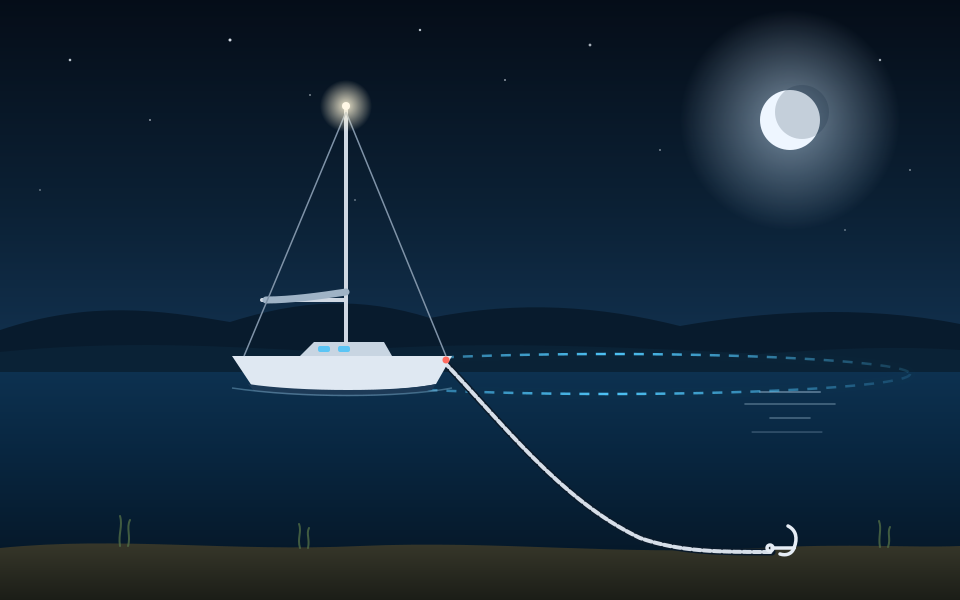
CapMate's chart layer flags seagrass and posidonia using EMODnet Seabed Habitats mapping. The anchor check warns when the anchor, or the circle the chain could sweep as the boat swings, falls over a mapped meadow. It gives the nearest clear patch as a distance and a bearing, not just a yes or no. It does not work out which country's law applies at that spot, and it does not estimate fines. Mapping coverage isn't complete everywhere, and you have to get the legal detail above by knowing where you are, not by letting the app guess a jurisdiction. A clear result from the seabed layer says something about habitat, not about legality.
Questions
Is anchoring on posidonia illegal everywhere in the Mediterranean?
No. It is restricted in most of it, but the law, the fine and the enforcer differ by country. Spain has a 2026 national ban plus an older Balearic decree. France restricts by season and boat length. Italy and Greece enforce through regional rules and general anchoring-zone law rather than a posidonia-specific statute.
What's the fine for anchoring on posidonia in Spain?
Under Balearic regional law, penalties run from €100 to €450,000, depending on severity. Spain's national nature-protection law can reach €2 million in the most serious cases. In a widely reported 2026 case in Pollença Bay, nine boat owners faced fines of up to €6,000 after patrol inspections.
Does France ban anchoring on posidonia for all boats?
No. The seasonal rule (1 June to 30 September, 2026 and 2027) restricts anchoring on posidonia and other sensitive habitats, so you anchor on sand or mud. A separate, older rule bans it outright for vessels over 24 metres (sometimes 20 metres locally), in any season.
Why are Italy's posidonia fines lower than Spain's?
Italy has no national posidonia-specific law. Enforcement and fines are set regionally and locally, typically at €200 to €1,500. Spain adds a 2026 national ban on top of the Balearics' own 2018 decree, with far higher penalty ceilings.
Can an app tell me if a specific spot is legal to anchor on?
It can tell you what the seabed is. CapMate flags mapped posidonia and seagrass and gives the distance to the nearest clear patch. The legal answer depends on which country's zones and rules apply there, and that is a different question from what grows on the bottom.
Sources
- Royal Decree 191/2026 (Spain) — national ban on anchoring over posidonia oceanica and Cymodocea nodosa, published 11 March 2026 — https://www.portroses.com/en/2026-to-protect-posidonia-in-the-mediterranean (2026-11-05)
- Balearic Decree 25/2018 and 2026 enforcement — Pollença Bay fines up to €6,000, penalty range to €450,000 — https://www.yacht.de/en/travel-and-charter/spain-and-portugal/balearic-islands-mallorca-tightens-controls-on-anchoring/ (2026-11-05)
- France — seasonal posidonia anchoring ordinance 2026–2027, boat-length rule, fine ranges — https://yachtmate.fr/blog/en/anchoring-regulations-france.html (2026-11-05)
- Mediterranean Posidonia Network — country-by-country regulation summary (Italy, Greece and others) — https://medposidonianetwork.com/regulations-and-solutions-copy-2/ (2026-11-05)